Introduction
Learning how to crate train an older rescue dog can be very different from crate training a young puppy. An older rescue may arrive with years of habits, unfamiliar experiences, or negative associations that you know nothing about. If that dog also struggles with separation fears or specific phobias, putting them into a crate and closing the door too quickly can increase their anxiety instead of making them feel secure.
The good news is that older dogs can learn new routines. The goal is not to make your rescue dog tolerate confinement. The goal is to teach them that the crate is a predictable, comfortable place where nothing frightening happens. Veterinary guidance also emphasizes that dogs with separation anxiety may need their anxiety addressed separately rather than simply being confined in a crate.
When you crate train an older rescue dog, patience is more important than speed. A dog that learns to enter willingly, relax with the door open, and gradually tolerate brief periods of separation is far more likely to develop a healthy relationship with the crate.
Why Crate Training an Older Rescue Dog Can Be Challenging
Puppies usually have limited previous experience with confinement. An older rescue dog is different. They may have lived in a shelter, spent time transported in a crate, been confined for long periods, or experienced punishment involving a cage.
You cannot know the complete history of every rescue dog. That uncertainty is why the first stage of training should focus on observation rather than control.
When you crate train an older rescue dog, pay attention to what happens around the crate. Does your dog approach it voluntarily? Do they freeze when they see it? Will they take a treat near the entrance? Do they become tense when you touch the door?

These details tell you how quickly you should progress.
A crate can provide a quiet retreat, make travel easier, support safe management, and give a dog a predictable resting area. However, a crate is not automatically the right solution for every anxious dog. If confinement itself causes panic, another safe area may be more appropriate.
Understand Separation Fear Before You Start
Separation anxiety and crate anxiety are not necessarily the same problem.
A dog may be perfectly comfortable inside a crate while you are sitting nearby but become distressed as soon as you leave. Another dog may panic as soon as the crate door closes, even though they remain calm when allowed to move freely around the house.
This distinction matters when you crate train an older rescue dog.
If the main problem is the crate, your training should concentrate on creating positive associations with that specific space. If the problem occurs whenever you leave the dog, even without a crate, you may be dealing with separation-related distress that requires a broader behavior plan.
Signs of serious distress can include frantic escape attempts, excessive panting, drooling, trembling, persistent pacing, destructive attempts to escape, or injuries to the mouth and paws. A dog that becomes increasingly distressed should not simply be left to “cry it out.” Severe panic can make the fear association stronger.
Create a Safe Crate Environment
Before you begin to crate train an older rescue dog, make the crate inviting.
Choose a crate that allows your dog to stand up, turn around, lie down, and change position comfortably. Avoid placing it somewhere noisy or constantly busy. At the same time, you do not necessarily want to isolate the dog from the entire household.
A location where the dog can observe normal family activity without being overwhelmed often works well.
Make the inside comfortable with suitable bedding and a safe enrichment item your dog already enjoys. If your dog guards food or toys, however, choose enrichment carefully and supervise the early sessions.
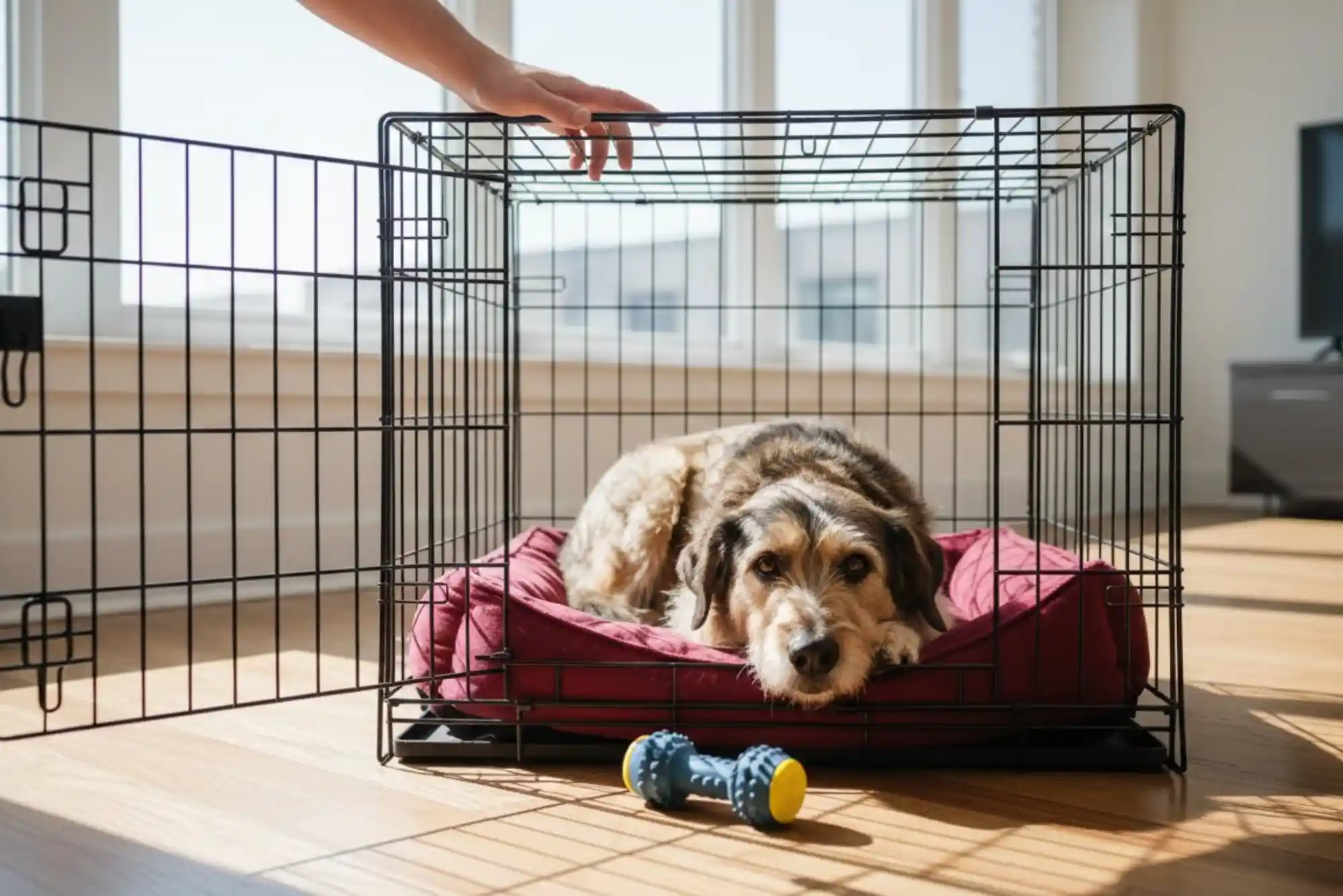
Most importantly, keep the crate door open at the beginning. Your dog should be able to investigate and leave without feeling trapped.
Let Your Dog Discover the Crate Voluntarily
The first major goal when you crate train an older rescue dog is voluntary entry.
Do not drag your dog inside. Do not push their body through the opening. Do not immediately shut the door when they finally step inside.
Instead, allow your dog to investigate at their own speed. You can place a high-value treat near the entrance and later move it slightly farther inside. If your dog enters, allow them to come back out.
Repeat this calmly.
Over time, your dog should begin to understand that entering the crate predicts something pleasant. Meals can also be introduced near the crate and gradually moved inside if your dog is comfortable eating there.
The important principle is simple: the dog should have a reason to choose the crate.
This voluntary approach is especially valuable for rescue dogs with unknown histories because it avoids forcing them into an environment that may already feel threatening.
Build Duration Before Closing the Door
Once your dog willingly enters the crate, resist the temptation to move quickly.
Many owners make the mistake of thinking, “My dog went inside, so now I can close the door.” For an anxious rescue, that can undo several days of progress.
Instead, let your dog remain inside while the door stays open. Reward calm behavior. If your dog lies down, relaxes their body, or settles quietly, allow that behavior to continue without excessive excitement.
Gradually increase the amount of time your dog spends inside voluntarily.
Only after your dog is consistently comfortable should you begin introducing the door.
When you crate train an older rescue dog, the door should initially move only slightly. Close it for a second or two and reopen it before anxiety appears. Repeat this many times during short sessions.
The objective is to teach your dog that a closed door is temporary and predictable.
Practice While You Are Still in the Room
Separation training should not begin with you walking out of the house.
First, help your dog become comfortable with you moving around while they are in the crate. Sit nearby. Stand up. Walk across the room. Return to your normal position.
Later, briefly move out of sight and come back.
This gradual process helps separate the concepts of “the crate” and “my person has disappeared.”
If your dog becomes anxious, shorten the exercise. A useful training session ends before your dog reaches panic. You want repeated experiences of success rather than repeated experiences of fear.
Short, frequent practice sessions are often more productive than one long session. Older dogs with anxiety may need considerably more time at each stage than confident adult dogs.
Introduce Real Departures Very Gradually
After your dog can remain calm in the crate while you move around the home, you can begin practicing departures.
Start with extremely short absences. Walk toward the door, step outside briefly, and return before your dog becomes distressed.
Do not immediately test whether your dog can handle 30 minutes or an hour.
When you crate train an older rescue dog with separation fears, your progress should be measured by the dog’s emotional response, not simply by the clock.
If your dog remains relaxed for 20 seconds, that is useful information. Build from there. If they panic after five seconds, five seconds is currently beyond their comfort level.
The aim is gradual desensitization: repeatedly exposing the dog to a manageable version of the trigger until the trigger becomes less emotionally significant.
Keep Departures and Returns Calm
Your behavior around departures can influence the overall routine.
Avoid turning every departure into a dramatic goodbye. Similarly, returning home should not always become an enormous emotional event.
A calm, predictable routine can make departures less significant.
You can establish a simple pattern in which the dog receives a safe enrichment activity, settles in the crate, and experiences a short absence. Over time, the routine itself becomes familiar.
However, enrichment is not a cure for severe separation anxiety. A severely distressed dog may refuse even favorite food when left alone. In such cases, professional assessment is more appropriate than simply adding more treats or toys.
Work Carefully Around Phobias
Some rescue dogs have fears that have nothing to do with the crate itself.
Thunderstorms, fireworks, traffic sounds, unfamiliar people, vacuum cleaners, certain surfaces, or sudden movements can all trigger fear responses.
If your dog has a noise phobia, for example, do not use a storm as the first opportunity to test how well they tolerate the crate.
Instead, establish crate comfort during calm periods.
A crate may eventually become a familiar retreat during stressful situations, but it should not be introduced for the first time when the dog is already frightened.
The same principle applies to travel and unfamiliar environments. A dog who already feels safe in the crate at home is more likely to cope with it when circumstances change.
Never Use the Crate as Punishment
One of the most important rules when you crate train an older rescue dog is to keep punishment completely separate from the crate.
Never send your dog into the crate because they behaved badly. Never yell at them while they are inside. Never use confinement as revenge for chewing, barking, accidents, or other unwanted behavior.
The crate should predict safety and rest.
If the dog learns that the crate appears whenever something unpleasant happens, their emotional association can change quickly. This is particularly problematic for rescue dogs that may already have a history of fear or confinement.
Know When Crate Training Is Making Things Worse
Not every dog should be pushed through crate training.
If your dog repeatedly attempts to escape, damages their teeth or paws, drools excessively, trembles intensely, screams continuously, or shows escalating panic, stop and reassess the plan.
A dog that is mildly frustrated may settle after a short period. A dog experiencing genuine panic is different.
If your rescue dog is safer and calmer in a dog-proofed room, pen, or another controlled environment, use that arrangement while you address the underlying anxiety.
Crate training should improve your dog’s ability to relax. It should not become a daily battle.
Professional help is particularly important if your dog has injured themselves, cannot tolerate even extremely short absences, or shows severe anxiety despite careful gradual training. A veterinarian or qualified veterinary behavior professional can help determine whether medical or behavioral treatment is appropriate.
How Long Does It Take to Crate Train an Older Rescue Dog?
There is no universal timetable.
A confident adult dog might become comfortable with a crate relatively quickly. A fearful rescue with previous confinement trauma may need weeks or considerably longer.
When you crate train an older rescue dog, avoid setting an arbitrary deadline such as “my dog must be crate trained in seven days.”
Instead, look for behavioral milestones. Your dog willingly enters the crate. Your dog can relax inside. Your dog remains calm when the door closes. Your dog tolerates you moving away. Finally, your dog can handle gradually increasing periods of separation.
Each successful stage becomes the foundation for the next.
Common Mistakes to Avoid
The biggest mistake is moving faster than the dog’s emotional readiness.
Another common problem is closing the crate door immediately after the dog enters. Owners may also expect the crate to fix separation anxiety by itself, when the underlying issue actually involves distress about being separated from a particular person.
Ignoring clear panic is another serious mistake.
Finally, avoid comparing your rescue dog with another dog. Your friend’s adult dog may have learned to love a crate within several days. Your rescue may need much longer because their history, temperament, and triggers are different.
Progress should be measured against your dog’s previous behavior, not someone else’s timeline.
Help Your Rescue Dog Feel Safe
Learning how to crate train an older rescue dog is ultimately an exercise in trust.
The crate should never be about forcing an anxious dog to endure something frightening. It should become a predictable space where your dog can rest, decompress, and feel secure.
Start with the door open. Reward voluntary exploration. Build duration slowly. Introduce separation in tiny increments and watch your dog’s body language carefully. If you see genuine panic, step back rather than pushing forward.
Most importantly, remember that a rescue dog does not need to become comfortable at the same speed as another dog. Patience is not a delay in the training process; for a fearful dog, patience is the training process.
FAQs
Can you crate train a dog with separation anxiety?
Yes, but the crate is not necessarily a treatment for separation anxiety. If the dog already feels comfortable in the crate, it can become part of a broader management and training plan. If the crate itself triggers panic, forcing confinement can make the problem worse.
How do I crate train an older dog who has never been in a crate?
Start with the door open and allow the dog to investigate voluntarily. Reward calm interaction with the crate and gradually encourage the dog to spend more time inside. Introduce the closed door only after the dog is comfortable entering and relaxing inside.
What should I do if my rescue dog cries in the crate?
First determine whether the dog is mildly protesting or experiencing genuine distress. If crying escalates into frantic escape attempts, heavy panting, drooling, trembling, or self-injury, stop the exercise and seek professional guidance. Do not assume that prolonged crying will automatically teach the dog to relax.
Is it cruel to crate a dog with separation anxiety?
Crating is not inherently cruel when a dog is properly introduced to the crate and remains comfortable there. However, confinement can be inappropriate for a dog who experiences severe panic inside a crate. In those cases, another safe management option may be better.
Can an older rescue dog learn to love a crate?
Yes. Age does not prevent learning. Older dogs can develop positive associations with a crate, although dogs with previous negative experiences may need a slower introduction and more repetition.
How long can an older dog stay in a crate?
The appropriate duration depends on the individual dog’s age, health, bladder control, temperament, and comfort with confinement. A crate should not become a place where a dog spends most of the day. If your dog needs longer periods of management, consider a safe room or another suitable arrangement.