
Introduction
Choosing the right tactical dog harness with handle is about much more than appearance. For large breeds, working dogs, and trained service dogs, a harness needs to provide dependable control without restricting movement or creating unnecessary pressure. A properly designed tactical harness can also provide useful attachment points, identification panels, padding, and a reinforced handle for close handling.
Large dogs can generate significant force when they pull, lunge, or change direction suddenly. That makes construction and fit particularly important. Current tactical harness designs commonly use reinforced nylon, multiple adjustment points, metal leash attachments, MOLLE-style webbing, and padded chest areas. However, the word “tactical” alone does not guarantee that a harness is strong or appropriate for a working dog.
This guide explains what to look for when choosing the best tactical dog harness with handle, how these harnesses work for large breeds and service dogs, and which features deserve the most attention before making a purchase.
What Is a Tactical Dog Harness with Handle?
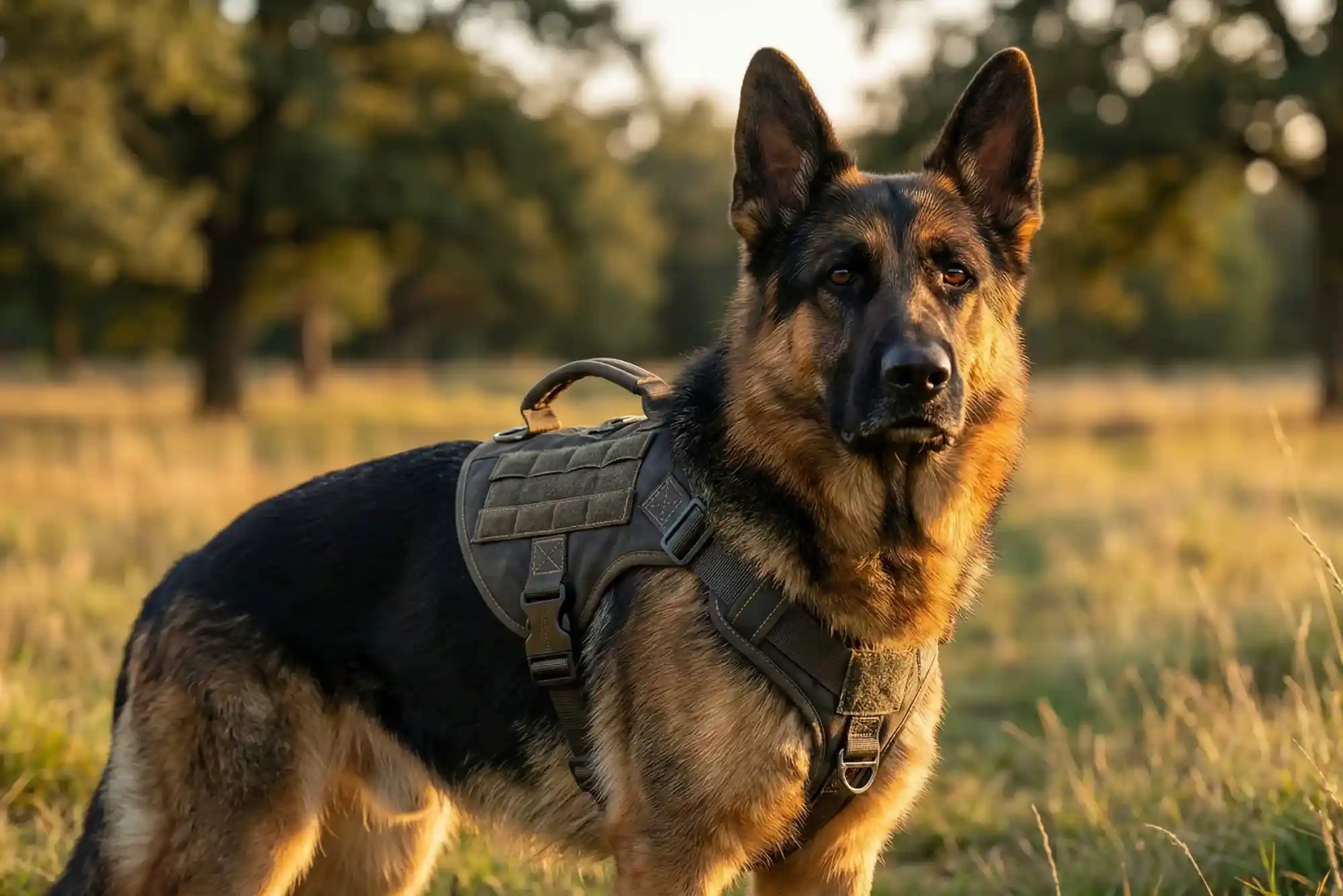
A tactical dog harness is generally a vest-style harness designed for increased control, durability, and versatility. Unlike a simple walking harness, it often includes a reinforced top handle, multiple leash attachment points, MOLLE-style webbing, hook-and-loop panels, and heavier-duty materials.
The handle is one of the most useful features for owners of large dogs. It gives the handler a direct grip on the dog’s body when quick control is necessary. This can be useful when moving through crowded areas, crossing difficult terrain, helping a dog over an obstacle, or briefly preventing a sudden movement.
It is important, however, not to assume that every handle is designed for lifting. Some manufacturers provide a reinforced grab handle without publishing a specific load rating. A handle should therefore be treated as a control point unless the manufacturer specifically states that it is rated for lifting.

Why Large Breeds Need a Stronger Harness
Large breeds have different harness requirements from smaller companion dogs. A German Shepherd, Rottweiler, Labrador, Husky, Belgian Malinois, or Mastiff can place substantial force on buckles, webbing, seams, and leash attachment points.
A well-designed tactical dog harness with handle distributes pressure across a broader section of the chest and torso instead of concentrating it around the neck. This is particularly useful for dogs that pull during walking or training.
The harness should also remain stable when the dog changes direction. If the vest rotates toward one side, rubs behind the front legs, or moves toward the neck, it may indicate an incorrect size or poor adjustment.
For large breeds, measurements matter more than the breed name. Manufacturers commonly provide chest-girth measurements, and some offer several adjustment points to accommodate dogs with deep chests and relatively narrow waists.
Key Features to Look for in a Tactical Dog Harness with Handle
Reinforced Control Handle
The top handle is arguably the defining feature of a tactical harness. For large dogs, look for a handle that appears structurally connected to the harness rather than simply sewn onto the outer fabric.
Reinforced stitching around the handle attachment points is important. Box stitching, cross stitching, bar-tack reinforcement, and heavy-duty webbing can indicate that the manufacturer has paid attention to high-stress areas.
Still, visual stitching alone does not establish a tested lifting capacity. If the manufacturer does not publish a handle rating, use it primarily for short-duration control rather than lifting the dog’s full body weight.
Durable Harness Material
Heavy-duty nylon is common in tactical harness construction. Current products use materials ranging from 1000D to 1050D nylon, although denier alone does not tell the entire story about durability.
The quality of stitching, webbing, buckles, padding, and load-bearing attachment points also matters. A thick fabric cannot compensate for a weak buckle or poorly reinforced seam.
Some current harnesses combine abrasion-resistant nylon with breathable mesh and padding in pressure areas. This combination can make a substantial difference during longer walks or outdoor activities.
Multiple Leash Attachment Points
A front attachment point can be useful during training because it can help redirect a dog that pulls. A rear attachment point is generally more convenient for everyday walking.
Having both gives handlers more flexibility. Some tactical harnesses also include additional attachment points, although more rings do not automatically mean better performance.
The attachment point should be securely integrated into the harness and designed for the intended use. For powerful dogs, avoid assuming that an accessory ring is suitable for high-force pulling simply because it is made from metal.
MOLLE and Hook-and-Loop Panels
MOLLE-style webbing is common on tactical harnesses. It allows owners or handlers to attach compatible pouches and lightweight equipment.
For service dogs, hook-and-loop panels can be particularly practical because they allow identification patches to be displayed. A harness may also provide space for small essentials such as treats, identification cards, or medication pouches, depending on the dog’s work and the handler’s requirements.
However, carrying additional equipment adds weight. Keep the dog’s comfort and mobility in mind rather than filling every available attachment point.
Best Tactical Dog Harness with Handle for Large Breeds
There is no single harness that fits every large dog. The best choice depends on the dog’s chest measurements, activity level, pulling strength, climate, and intended use.
For large breeds needing a combination of control and tactical features, the Leader K9 Tactical Dog Harness is one example of a design focused on large working and outdoor dogs. Its manufacturer describes a 1050D nylon construction, five adjustment points, metal leash attachment hardware, MOLLE panels, padding, and a reinforced top handle.
Another option worth considering is the OneTigris GUARDIAN harness. Its design combines a grab handle, front and rear leash attachment points, MOLLE-compatible sections, patch panels, padding, and 1000D nylon. The manufacturer specifically positions it for service and working dogs, including larger breeds.
For handlers working with exceptionally large dogs, sizing becomes even more important. Some specialized tactical K9 harnesses are offered in XL and XXL sizes and are designed around working breeds used in demanding environments. Shark Fin Gear, for example, lists sizes through XXL and provides hardware options with stated load ratings.
The important takeaway is that a harness should be selected based on actual measurements and intended use rather than simply choosing the largest available size.
Best Tactical Dog Harness with Handle for Service Dogs
Service dogs have different needs from recreational hiking dogs. Identification, comfort, stability, and ease of handling can all be important.
A tactical dog harness with handle can provide a convenient way to maintain close control while also providing space for service-related identification patches. Some designs include MOLLE sections for carrying small supplies and hook-and-loop panels for clearly visible identification.
The OneTigris GUARDIAN, for example, combines service-dog identification space with a grab handle, multiple D-rings, padding, and MOLLE pouches.
Hellgar also markets a tactical harness specifically toward service and working dogs. Its product information describes a reinforced handle, no-pull leash rings, four adjustment points, heavy-duty stitching, and MOLLE compatibility. The available sizes extend from dogs below 40 pounds through an extra-large option for dogs weighing 100–130 pounds.
One important distinction should always be remembered: wearing a service-dog vest does not make a dog a service animal. The harness is equipment. The dog’s training and legally recognized role are separate matters.
How to Choose the Correct Harness Size
Getting the correct size is more important than choosing the heaviest-looking harness.
Start by measuring your dog’s chest girth around the deepest part of the rib cage, generally just behind the front legs. Follow the manufacturer’s instructions because measurement points can vary between products.
The harness should be secure without squeezing the chest. You should generally be able to place approximately two fingers between the harness and your dog’s body, while checking that the vest does not rotate excessively during movement.
Pay particular attention to the front legs. The harness should not continuously rub the armpits or interfere with normal shoulder movement.
A harness that is too loose may allow an escape, while one that is too tight can cause discomfort and rubbing. For large breeds with unusual body proportions, adjustable straps are especially valuable.
Are Tactical Harnesses Comfortable for Dogs?
A tactical harness can be comfortable, but comfort depends heavily on its design and fit.
Large tactical vests often use padding around the chest and pressure areas. Breathable mesh can also help reduce heat buildup, which matters during warm-weather walks.
At the same time, heavy-duty materials can make a tactical harness substantially heavier than a lightweight everyday harness. If your dog spends hours wearing it, the additional weight and heat should be considered.
A dog should also be allowed to move naturally. Watch the shoulders, elbows, chest, and back while the dog walks, trots, turns, and sits. If the harness changes position significantly or restricts movement, adjustment or a different design may be necessary.
Tactical Harness vs. Regular Dog Harness
A regular harness may be perfectly suitable for a dog that walks calmly and does not need additional equipment.
A tactical harness becomes more useful when the owner needs features such as a reinforced handle, multiple attachment points, MOLLE webbing, identification panels, or heavier-duty construction.
For example, a recreational Labrador that walks politely may not need a large tactical vest. A working German Shepherd that needs close handling and identification space may benefit from those additional features.
The goal should not be to choose the most rugged-looking harness. Instead, choose the design that provides the features your dog actually needs.
Common Mistakes When Buying a Tactical Dog Harness
One common mistake is buying based on the word “tactical” rather than examining the construction. Many products use tactical styling, but that does not necessarily mean their handles, buckles, or leash points are designed for demanding use.
Another mistake is choosing a size based only on the dog’s weight. Two dogs with the same body weight can have dramatically different chest and neck proportions.
It is also easy to overload MOLLE panels with unnecessary accessories. Extra pouches can increase weight and heat without providing meaningful benefits.
Finally, never assume that a top handle automatically means the harness is designed for full-body lifting. Unless the manufacturer explicitly provides a lifting or load rating, use the handle primarily for controlled positioning and short-duration restraint.
How to Maintain a Tactical Dog Harness
Even a heavy-duty harness needs regular inspection.
Check the stitching around the handle, leash rings, adjustment points, and buckles. Look for frayed webbing, cracked hardware, stretched seams, or damaged padding.
Clean the harness according to the manufacturer’s instructions. Mud, salt, sweat, and moisture can gradually affect materials and hardware.
If any load-bearing component becomes damaged, replacing the harness is generally safer than continuing to use it. A tactical harness is only as reliable as its weakest component.
Choosing the Right Tactical Dog Harness with Handle
The best tactical dog harness with handle is not necessarily the heaviest or most expensive option. It is the one that fits your dog correctly, provides reliable control, uses appropriate materials and hardware, and offers features that match your dog’s actual work or lifestyle.
For large breeds, prioritize chest fit, shoulder freedom, reinforced attachment points, durable webbing, and a properly constructed handle. For service dogs, consider identification panels, comfort during extended wear, easy adjustment, and practical space for essential equipment.
Before buying, measure your dog’s chest carefully and compare those measurements with the manufacturer’s sizing chart. Inspect the handle and load-bearing areas, and avoid assuming that tactical styling equals working-grade strength.
FAQs
What is the strongest tactical dog harness?
Strength depends on the construction, hardware, stitching, and intended load rather than the word “tactical” on the label. Some manufacturers publish hardware load ratings, while others do not. OneTigris X-Armor, for example, publishes ratings for certain buckles and D-rings, while other popular tactical harnesses provide less detailed load information.
What is the best harness for a large dog that pulls?
A harness with a properly positioned front attachment point, secure chest fit, reinforced construction, and appropriate adjustment range can be useful for a strong puller. However, equipment should complement leash training rather than replace it. The correct choice depends on the dog’s measurements and behavior.
Are tactical dog harnesses good for service dogs?
They can be. Tactical harnesses can provide identification panels, a control handle, secure leash attachment points, and space for lightweight equipment. Several current designs are specifically marketed for service and working dogs.
Is a handle on a dog harness useful?
Yes. A handle can provide immediate close control when a handler needs to steady or redirect a dog. It can be particularly useful with large dogs in crowded environments or difficult terrain. However, the handle should not automatically be treated as a lifting point unless its load capacity is specifically stated.
Should a tactical dog harness be tight or loose?
It should be secure without being restrictive. A loose harness can allow a dog to escape or cause the vest to shift, while an overly tight harness can cause rubbing and discomfort. Use the manufacturer’s sizing chart and check the fit while your dog is moving.
Can a tactical dog harness stop a dog from pulling?
A tactical harness can provide better handling and, when it includes an appropriate front attachment point, may help redirect pulling. It does not independently teach a dog not to pull. Consistent positive-reinforcement training remains important for long-term leash behavior.